.webp)
EDR Security: Your EDR Is Watching. But Who's Watching It?
.png)
Deploying endpoint security isn't the same as being protected.
There's a belief that has become almost universal in the industry: once you've deployed an endpoint security product, you've addressed the threat. You've checked the box. You're covered.
The reality is that endpoint detection tools are genuinely effective, and attackers know it. That's exactly why the most sophisticated ones don't try to smash through your security controls. They study the gaps, move slowly, and blend into the noise that sits at the edges of what any tool, however capable, is designed to catch.
This blog is about understanding how that happens, and what it takes to close the gap.
Phase One: Getting Through the Door of EDR Security
The first challenge for any attacker is simply getting their code to run on a target machine at all. Between email filtering, browser warnings, antivirus scanning, and built-in OS protections, there's a real gauntlet standing between a malicious file and the moment it executes.
To navigate this, attackers use a small, disposable program whose only job is to smuggle the real payload past those defenses. It doesn't need to be permanent. It just needs to work long enough to hand off control. Once it does, it becomes irrelevant.
What's notable about this phase isn't any single technique, it's the mindset. Attackers are constantly watching which file types and delivery methods security tools inspect most carefully, and they shift to whatever falls outside that scrutiny. When email filters got better at spotting certain attachment types, attackers moved to disc images. When those were patched, they shifted to shortcut files, then to web pages that assemble the malicious content directly inside the browser, nothing suspicious ever arrives over the network at all.
The specific method changes with the season. The logic behind it doesn’t.
Looking legitimate before doing anything suspicious
Many of these programs are also built to check their surroundings before revealing what they do. They look for signs they might be running inside a security researcher's testing environment, limited system resources, no browsing history, no normal user files, and if anything seems off, they shut down quietly without ever showing their hand.
Others simply wait. Some do nothing for several minutes before executing anything meaningful, since automated analysis environments rarely observe that long. The payload only appears when the program is confident it's running in a real, unmonitored environment.
The result is that many of these programs pass through security scanning without ever being flagged. Not because the scanning is bad, but because they're specifically designed to look harmless until the moment, they aren't.
Phase Two: Operating Without Getting Caught
Once an attacker has a foothold, the challenge changes completely. They're no longer trying to survive a single moment of scrutiny. They're trying to operate undetected for an extended period. Sometimes weeks, mostly months.
This is the phase that's harder to defend against, because the techniques involved are built for the long game. The attacker isn't racing, they're being methodical.
Blending into the environment
After gaining initial access, a skilled attacker doesn't stay where they landed. They move their tools into software your system already trusts. Background services, browsers, everyday applications, so their activity looks indistinguishable from normal operations. They communicate outbound over the same encrypted channels your organization uses for legitimate web traffic. And when they need to move to another machine or access sensitive data, they lean on the same remote-access and administration tools your IT team uses every day.
From the outside, all of this looks like routine work. And that's exactly the point!. The most dangerous attackers aren't the ones trying to hide. They're the ones who've made themselves look like they belong.
The most underrated technique: Patience
Security tools work by looking for patterns. Specifically, they look for patterns that happen close together in time. When several unusual events occur within the same window, a process spawning unexpectedly, a connection to an unfamiliar address, a file being created in an odd location, the correlation engine can assemble those signals into an alert.
Sophisticated attackers know this. So, they deliberately slow down. Initial access one week. Internal reconnaissance two weeks later. Moving to the next target machine a week after that. Each individual step, viewed in isolation, looks unremarkable. By the time enough has happened to tell a story, the window for automatic correlation has long since closed.
This isn't a new idea, but it remains one of the most effective approaches precisely because it requires almost no specialized tooling to execute. The attacker's only real requirement is discipline.
Why “We Have EDR security” Isn’t Enough
Endpoint security products are built to work everywhere. Across every industry, every company size, every network architecture. To do that, they ship with generic rule sets calibrated for breadth. They're very good at catching well-known, widely-seen attack patterns. But they have no idea what's normal for your specific organization.
Modern endpoint tools have come a long way. Many now include machine learning engines that study behavioral patterns and flag deviations, they're not just running static signatures anymore. That matters, and it's a genuine capability.
But there's a difference between a model that's learned what endpoints generally look like across millions of deployments, and a team that understands your business. ML can tell you that something is statistically unusual. It can't tell you that the remote-access session happening right now is your IT admin doing routine maintenance. Or an attacker who's been inside for three weeks. It surfaces the anomaly. Someone still must know your environment well enough to decide what it means.
The most patient attackers understand this too. They don't trigger anomalies, they move slowly enough, and through trusted enough channels, that nothing ever looks statistically out of place. They stay inside the model's definition of normal, and they stay there deliberately.
That context is everything. And it's exactly what generic rules are structurally unable to provide.
The comparison that matters
The difference between out-of-the-box detection and detection tuned to your environment isn't subtle. Here's what it looks like in practice:
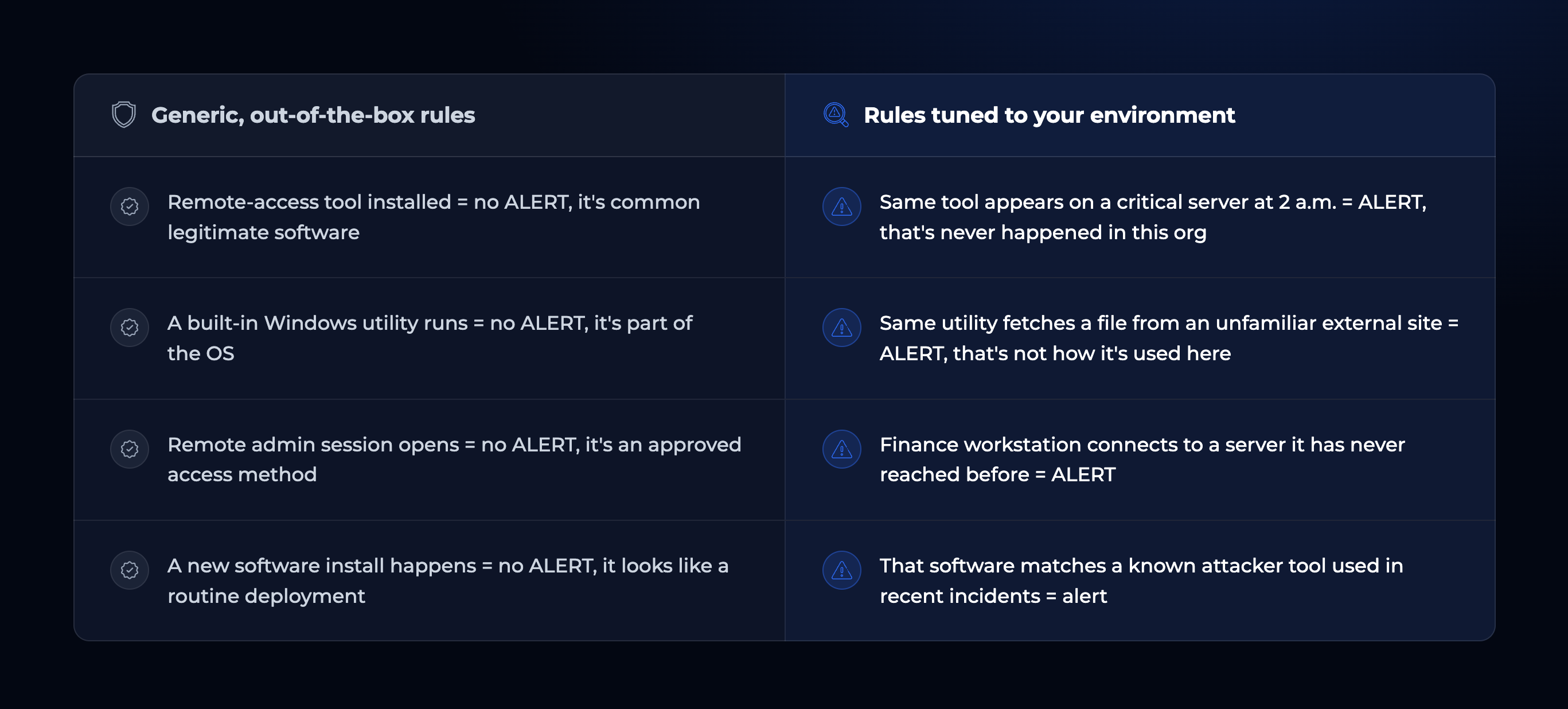
The left column isn't an indictment of bad EDR security vendors. It's an honest description of what any rule set built for the entire market has to look like. The right column is only possible when someone has actually learned your environment, your approved tools, your normal traffic patterns, your expected administrative behavior, and built detection logic around what's specific to you.
What This Means for Your Security Posture
If your organization's primary security investment is an endpoint protection product running on default settings, you have a gap. Not because the product is bad, but because no product shipped for every customer everywhere can know what's specific to you. And attackers will find what it doesn't know.
Closing that gap requires more than adding another security tool. It requires detection that understands your environment, continuous threat hunting that looks beyond individual alerts, and experienced analysts who can connect seemingly unrelated events into a bigger picture.
That's the role an effective MDR service should play alongside your existing EDR security solution. The goal isn't to replace the tools you already have, but to make the security telemetry they generate more meaningful, more contextual, and more actionable.
At COGNNA, our MDR service is built around this exact model: environment-specific detection, continuous threat hunting, and a human layer that brings judgment where automation alone falls short. At the core is an agentic SOC, where AI agents work continuously across your environment, correlating signals, identifying deviations from established patterns, and surfacing activity that may otherwise go unnoticed. Guardian experts then investigate, validate, and act on what matters.
Because having EDR security is not the same as knowing what it's seeing.
The question isn't whether your EDR is watching. It's whether someone is watching what your EDR isn't telling you.
If you're relying on EDR security to protect your business, try COGNNA’s smart MDR service on your existing stack.

.webp)