.webp)
The Post-Mythos World: Race against time and AI

Artificial intelligence isn’t the future, it is already our present. In the timeline of technology, the preview release of Claude Mythos will likely be remembered as the exact moment cybersecurity was permanently reinvented.
On one hand, the deployment of Claude Mythos Preview for coding and software development brings immense optimism, promising unprecedented speed and efficiency to engineering teams. On the other hand, this exact same model presents a stark dual-use dilemma for cybersecurity: it is simultaneously a fundamental threat to the status quo and a massive opportunity for future resilience.
In the current situation where information is free-flowing and first takes are overwhelming, forming an opinion based on loud headlines, unformed opinions, hasty takes, and vested advice is a slippery slope.
My recommendation to all cybersecurity and business leaders is to read the original source of information first to build a baseline opinion, and then swipe left or right on third-party positioning. One of the most common prevailing perceptions in the industry is that the Mythos preview was a special-purpose model for cybersecurity. However, Mythos Preview wasn't trained and built for cybersecurity capabilities. Rather, they emerged as a downstream consequence of general improvements in code, reasoning, and autonomy. It was supposed to be a general-purpose model for general software engineering and autonomous coding.
The Impact of The AI world in Cybersecurity:
Shifting the Yardstick: From Months to Minutes
Traditionally, cybersecurity metrics were measured in days, weeks, or months. Moving forward, security teams will no longer have the luxury of time. Because AI executes actions in minutes rather than days, defense metrics must immediately shift to hours and minutes.
The True Power of Frontier AI (And Why Traditional Defenses Fail)
Frontier AI models like Claude Mythos Preview are fundamentally altering defensive math. When run against an application's codebase within an isolated container deployment, Mythos can discover novel vulnerabilities within hours—flaws that remain completely invisible to existing Static Application Security Testing (SAST) scanners, or that would otherwise take human researchers several days of iterations to uncover.
For context, Claude Mythos Preview successfully discovered a 27-year-old vulnerability in OpenBSD within hours.
However, the discovery of a single vulnerability isn't the biggest concern—vulnerability chaining is. These advanced models can autonomously stitch together three or four low-severity, seemingly benign flaws to map out a devastating, high-impact attack path. Because they can generate working exploits simultaneously, the traditional window between a vulnerability being found and an exploit being deployed has effectively collapsed.
Anthropic’s measured approach of releasing the Mythos preview via limited rollouts to Project Glasswing partners (recently expanded from 50 to over 150 firms) is highly commendable. A successful cyberattack on any of these major enterprises could impact more than 100 million people; securing the highest-impact environments first was a critical necessity.
The New Cyber Reality: Human Scale vs. Machine Scale
To understand how drastically the defensive landscape has shifted, we must look at how traditional processes collapse under machine-speed tracking:
The Domino Effect: What End Users Must Brace For
As an end user of this technology, the industry must prepare for a cascading series of operational bottlenecks:
- The Patching Chokepoint: An explosion of newly uncovered CVEs will lead to an overwhelming volume of patches, completely choking traditional patch management processes.
- System Administrator Burnout: Infrastructure teams will face severe burnout trying to deploy fixes at an impossible pace.
- Increased Business Disruption: The risk of operational downtime will skyrocket due to rushed patches breaking live systems, compounded by the sheer frequency and speed of incoming attacks.
- The Visibility Gap: Attacks are more likely to go undetected. SOC teams will be paralyzed by overwhelming alert volumes stemming from autonomous vulnerability chaining, manual alert stitching, and a lack of context.
- Hyper-Burnout in the SOC: Manual processes for triage, investigation, and response create human-dependent bottlenecks that slow decision-making to a crawl.
As security leaders, we must remind ourselves: Not every vulnerability carries production risk. Deploying software with robust network segmentation, zero-trust access controls, and runtime behavioral monitoring can nullify an exploit even before a patch is ever issued. The goal is not a zero-bug environment; the goal is cyber resilience.
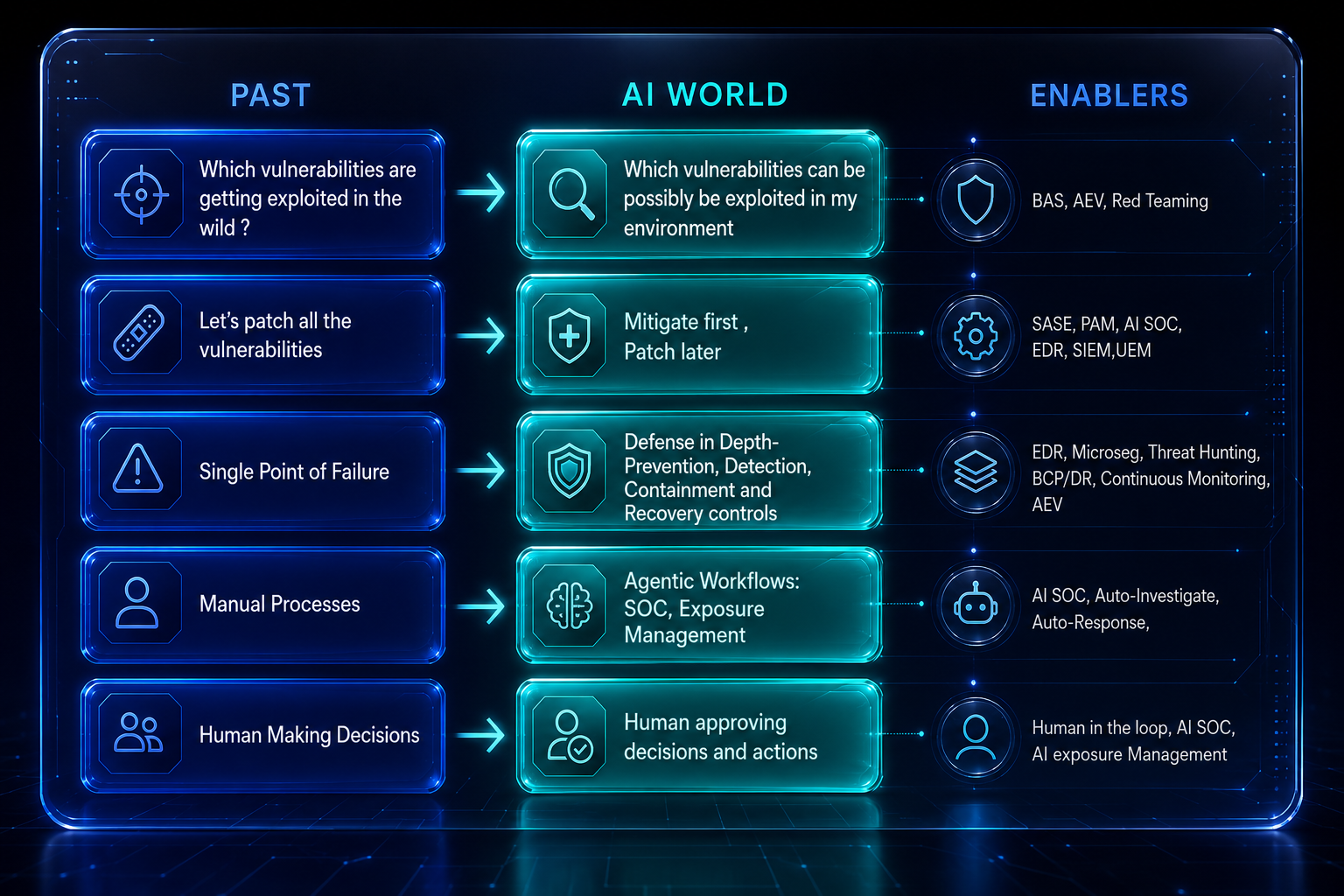
Top 5 Recommendations to the security leaders:
While the foundational principles of cybersecurity remain the same, speed, intelligence, relevance, and adaptation are now the key to survival.
1. Shift from Global Relevance to Local Relevance
The sheer number of global vulnerabilities no longer matters. The only vulnerabilities that carry actual risk are those that are actively exploitable within your specific environment, given your existing security controls, network architecture, and segmentation. Use Breach and Attack Simulation (BAS), Automated Exploit Validation (AEV), and Continuous Automated Red Teaming (CART) to continuously test real-world exploitation risk, and use that targeted intelligence to prioritize your defenses.
2. Implement Risk-Free Risk Reduction
Complete risk elimination is a myth; even immediate patch deployment cannot reduce risk to zero. Instead, use localized intelligence to implement immediate compensatory controls:
- Push Indicators of Attack (IOAs) and SIGMA rules directly to your SOC for automated detection.
- Break the kill chain by limiting access to pivotal systems to a small number of whitelisted IPs or users.
- Enforce strict microsegmentation to drastically contain the blast radius of a breach.
- Implement zero trust principles.
3. Adopt a Layered, Deterrence-Based Defense
Relying on a single security control has always been a risk, but AI’s agentic ability to recursively probe defenses makes it a critical failure point. The best defense is to drive the financial and computational cost of the attack as high as possible. Introducing complex, layered obstructions forces an attacker's AI to consume more time and expensive API tokens. A layered approach ensures higher deterrence and better structural resilience.
4. Fight AI with AI (The Machine-vs-Machine Era)
As vulnerability discovery and exploit chaining accelerate, your SOC will be hit with an unprecedented volume of alerts. Adding more human analysts to manual processes will not solve a mathematical problem. Alert triaging, investigation, and response must be driven through autonomous, agentic AI workflows.
History provides an excellent precedent here. During World War II, the Allied forces attempting to crack the German Enigma code using human brainpower alone was like trying to empty the ocean with a teaspoon. It wasn’t just a matter of human intelligence; it was a brutal game of mathematics and time. Alan Turing realized that to defeat a machine, you needed a machine. This shift is estimated to have shortened the war by two to four years and saved millions of lives. The cybersecurity industry needs that exact same Eureka moment today.
5. Prioritize Speed over Total Control
The industry’s most common conundrum is that humans do not want to cede control, which inherently inhibits speed. In the age of AI, speed is paramount. Because attacks now move at machine velocity, humans can no longer sit in the middle of every tactical decision loop. Security leaders must step back and become high-level supervisors—overseeing automated SOC actions, validating high-criticality mitigations, and governing the autonomous control plane.
Conclusion
The post-Mythos era does not change the core principles of cybersecurity; it simply demands the immediate inclusion of speed, adaptation, continuous intelligence, and context.
This shift does not spell the end of effective defense—it spells the end of manual defense. The winners of this paradigm shift will be those who recognize that you cannot fight machine-speed threats with human-scale processes.
.JPG)
.webp)